
Types of Surfboards: Every Board Explained & Which One to Ride
October 12, 2026
It's your first morning at the surf camp. The sun's barely up, the coffee's still kicking in, and you're standing in front of a rack of surfboards in every size and colour you can imagine. Big chunky foamies. Long, elegant logs. Stubby little fish with split tails. Skinny, pointy shortboards that look like they'd sink if you breathed on them. And the only question in your head is: which one's mine? 👀
Good news: you don't need to know the answer yet. But it helps to know what you're looking at. The different types of surfboards exist for a reason, and each one changes how a wave feels under your feet. Pick the right board and surfing feels fun and doable. Pick the wrong one and even a perfect little wave feels impossible.
Let’s break down the main types of surfboards, what each one is designed for, who they suit best, and how to figure out which board makes the most sense for you!
What are the main types of surfboards?
The main types of surfboards are soft tops, longboards, mini mals, funboards (mid lengths), eggs, hybrids, fish, mini simmons, grovellers, shortboards, step ups and guns. Roughly speaking, they run from big, stable and forgiving to small, fast and demanding!
Here's the quick version, from easiest to hardest to ride:
Soft top: A big foam board, super stable, where almost everyone starts.
Longboard: 9 feet or more, glides on the smallest waves, all about style.
Mini mal: A shorter longboard and the classic step after your first foamie.
Funboard / mid length: The in-between board, easy to paddle but easier to turn.
Egg: A rounded, forgiving mid length built for relaxed, flowing surfing.
Hybrid: Part shortboard, part fish, part funboard, made for everyday waves.
Fish: Short, wide and fast, a small wave favourite.
Mini simmons: Very short and very wide, pure speed in weak surf.
Groveller: A shortboard shape with extra volume for small, mushy days.
Shortboard: The high performance board you see in pro surfing.
Step up: A slightly longer shortboard for bigger, more powerful waves.
Gun: Long, narrow and pointed, built for serious big wave surfing.
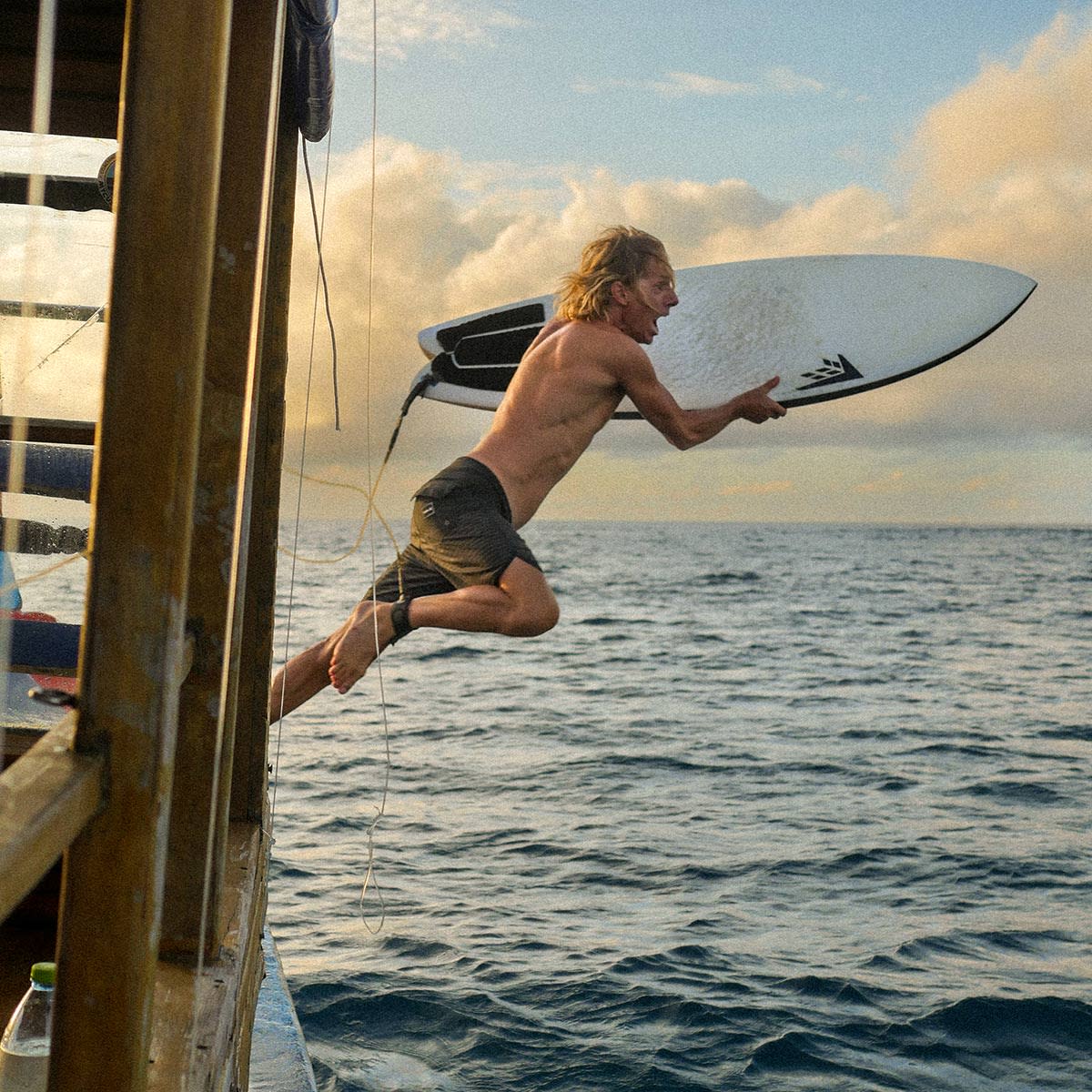
Why are there so many different surfboard shapes?
Because every shape trades stability for manoeuvrability. More length and volume means easier paddling, more waves caught and fewer wipeouts. Less length and volume means sharper turns and more speed, but only if you already have the skills to use them.
A few things change how a board rides:
Volume: How much foam is in the board, measured in litres. More volume floats you higher, paddles faster and feels more stable.
Length: Longer boards catch waves earlier and glide further. Shorter boards turn quicker.
Rocker: The curve from nose to tail. Flatter boards are faster on small waves; more curve helps a board fit into steep, powerful waves without nosediving.
Tail shape: A round or pin tail holds in bigger waves, a squash tail is a versatile all rounder, and a swallow tail adds looseness and speed on small days.
Fins: The number and setup of fins changes how drivey or loose the board feels (more on that below).
That's the short version. If you want to know what every rail, stringer and nose actually does, our surfboard anatomy guide breaks down every part of a surfboard.
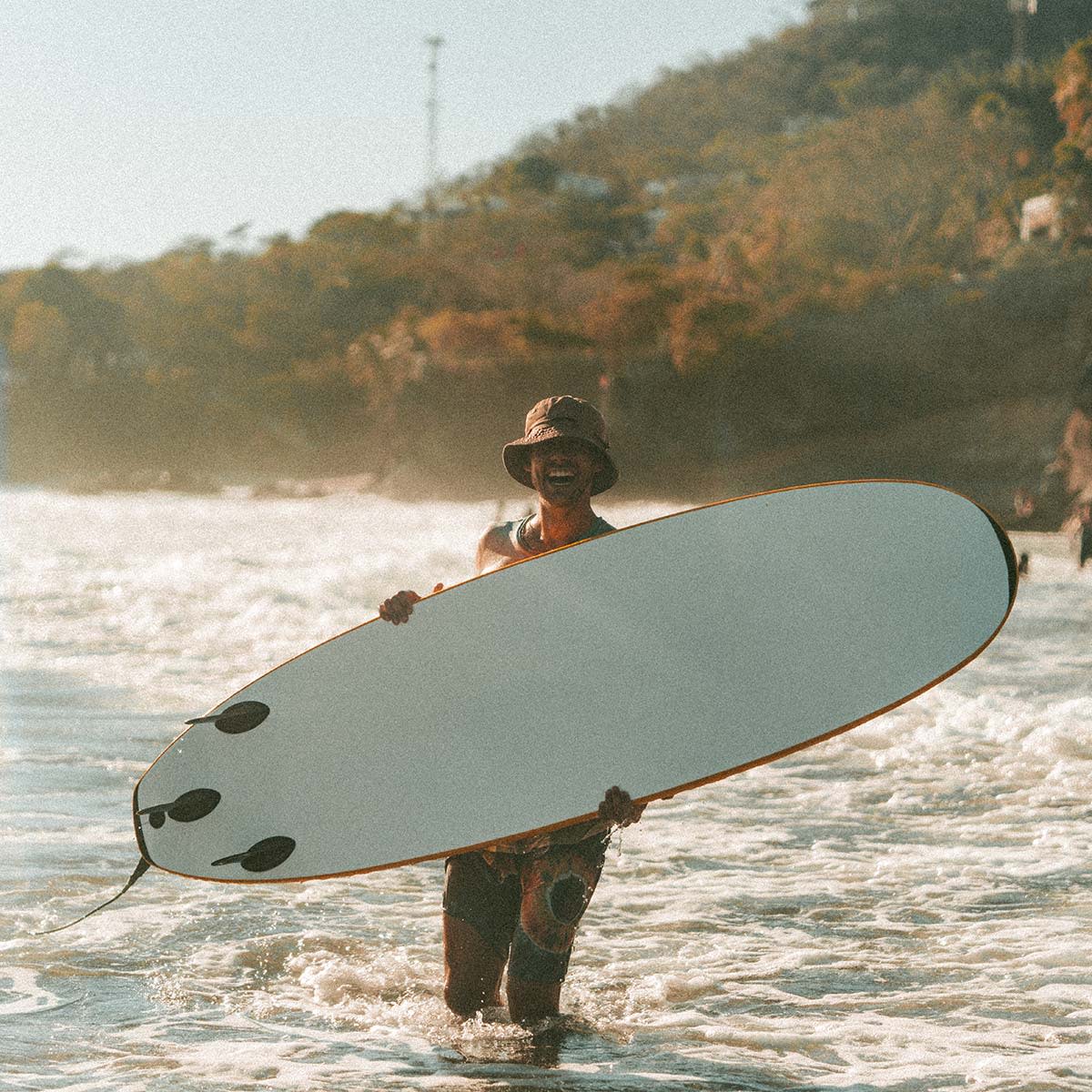
What type of surfboard should a beginner use?
A big, high volume soft top or longboard, roughly 8 to 9 feet long. It paddles easily, catches waves early and forgives the (many, totally normal) mistakes you'll make in your first sessions. That's exactly why, in our Level 1 beginner course, we put everyone on soft tops between 9'0 and 8'0 with extra flotation.
Here are the three boards you're most likely to learn on:
Soft top (foam board or foamie)
A soft top is a surfboard with a soft foam deck instead of a hard fibreglass finish. It's the board surf schools use for beginners, and for good reason: it's stable, buoyant and much kinder when it bumps into you (or you bump into it). Don't let anyone tell you foamies are just for beginners, either. Plenty of experienced surfers keep one around for fun, small days.
Good to know
Typical length: Roughly 8'0 to 9'0
Best for: First sessions, whitewater and small, mellow breaks
Level: Beginner
Vibe: Stable, forgiving, zero intimidation

Longboard
A longboard is a long, wide surfboard, usually 9 feet or more, with a rounded nose. It's the original surfboard shape, and it's still one of the most beautiful ways to ride a wave. Longboards catch waves early, glide through flat sections and let you walk up and down the board. Classic, heavy longboards built for noseriding are often called logs or noseriders. The flip side? They're heavy, harder to turn, and tricky to push through breaking waves when the surf gets bigger.
Good to know
Typical length: Roughly 9'0 and up
Best for: Small to medium, clean, gentle waves
Level: Beginner to Advanced (easy to start, a lifetime to master)
Vibe: Smooth, stylish, relaxed
Mini mal (mini Malibu)
A mini mal is basically a shorter longboard, usually somewhere around 7 to 8 and a half feet. It keeps a lot of the paddle power and stability of a longboard but is lighter, easier to carry and easier to turn. For many surfers, it's the natural next step once you're ready to leave the whitewater and start chasing green waves. We cover this stage in our blog on the green wave surfboard.
Good to know
Typical length: Roughly 7'0 to 8'6
Best for: Catching your first unbroken green waves
Level: Beginner to Lower Intermediate
Vibe: Friendly, confidence building

What surfboard comes after your first foamie?
Most surfers move to a slightly shorter but still forgiving board, like a funboard, egg or hybrid, once they're catching green waves on their own. This is the in-between zone most surf guides skip over, and it's where most people actually spend a big chunk of their surfing life.
Funboard / mid length
A funboard, often called a mid length, sits right between a longboard and a shortboard. It's short enough to turn properly but still has the volume to paddle easily and catch plenty of waves. So, funboard vs longboard? A longboard glides and trims; a funboard turns. If you've been on a longboard and want to start carving instead of cruising, a funboard is usually the answer.
Good to know
Typical length: Roughly 6'6 to 8'0
Best for: Everyday small to medium waves
Level: Lower Intermediate to Intermediate
Vibe: Fun (it's in the name), versatile, easygoing
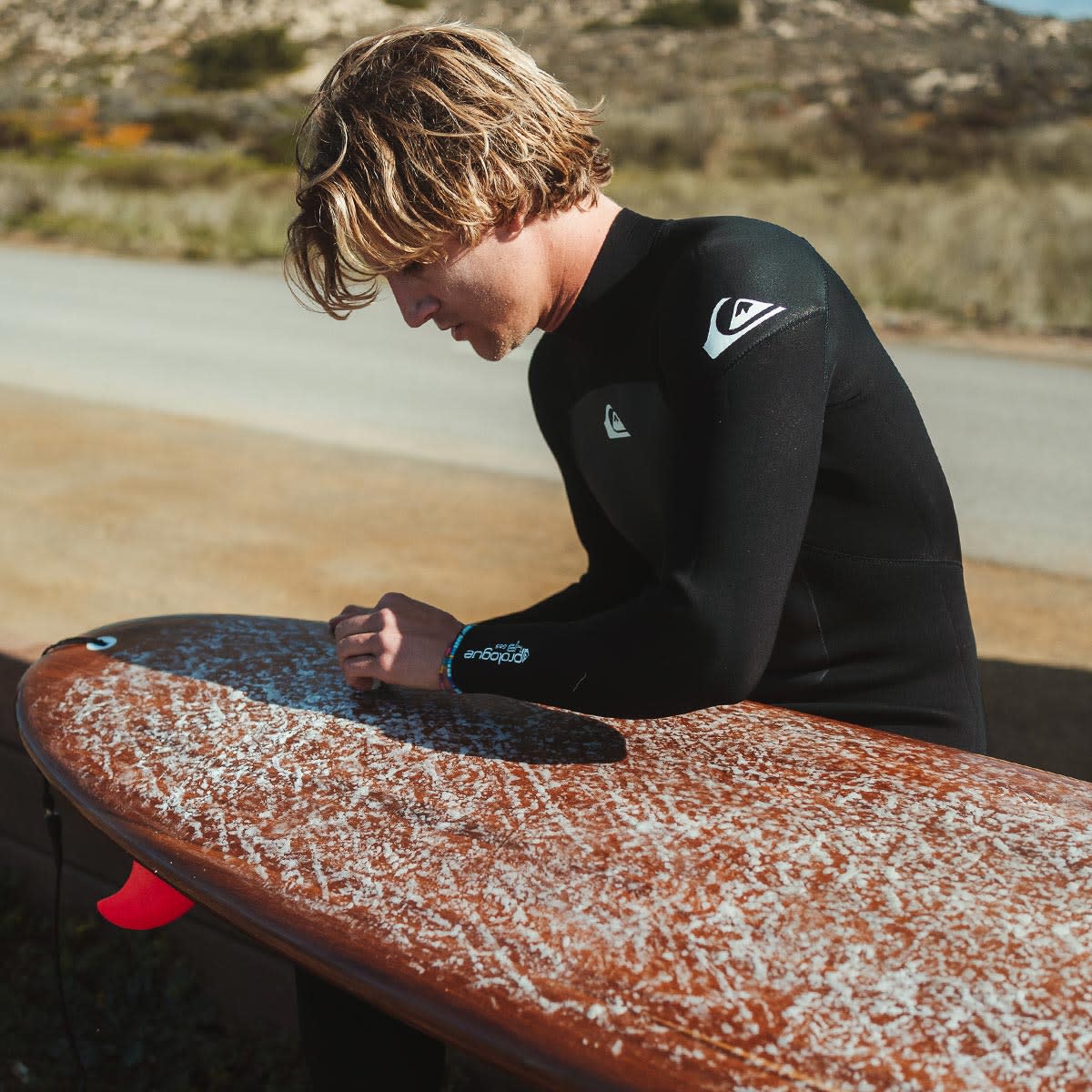
Egg
An egg is a mid length with a rounded outline, a round nose and a round tail, which makes it look, well, a bit like an egg. It's forgiving, smooth through turns and great for surfers who want a relaxed, flowing style rather than sharp, aggressive manoeuvres.
Good to know
Typical length: Roughly 6'6 to 8'0
Best for: Mellow, rolling waves
Level: Lower Intermediate to Intermediate
Vibe: Soulful, smooth, laid back
Hybrid
A hybrid blends design elements from different boards, usually a shortboard's rocker with some of the width and volume of a fish or funboard. The result is a board that's more forgiving than a shortboard but livelier than a mid length. A lot of surfers call their hybrid their "daily driver"!
Good to know
Typical length: Roughly 5'8 to 7'0
Best for: Average, everyday conditions
Level: Intermediate
Vibe: Versatile, playful, a real all rounder
What are the best surfboards for small or weak waves?
Fish, mini simmons and grovellers. These are short, wide, flat boards designed to generate speed where a regular shortboard would bog down and stall. If you surf somewhere with lots of small, mushy days, one of these could make every session twice as fun.
Fish
A fish is a short, wide surfboard with a split swallow tail and, traditionally, twin fins. It has a flatter rocker and more volume than a shortboard, so it paddles well and flies down the line in small to medium waves. What's the difference between a fish and a shortboard? A fish is wider, flatter and faster in small waves; a shortboard is narrower and more curved, built to turn hard in steeper, more powerful surf.
Good to know
Typical length: Roughly 5'0 to 6'6
Best for: Small to medium waves with some shape
Level: Intermediate
Vibe: Fast, loose, a little retro

Mini simmons
A mini simmons is a very short, very wide board with a square nose and a wide, square tail. It looks strange the first time you see one, but it's ridiculously fast and fun in small, weak waves. Because it's so short, it takes a bit of getting used to.
Good to know
Typical length: Roughly 5'0 to 6'0
Best for: Small, weak, crumbly waves
Level: Intermediate
Vibe: Quirky, speedy, pure fun
Groveller
A groveller is a shortboard with extra width and volume and a flatter rocker, made for small, lacklustre days. For shortboarders, it's the board you grab when the waves are too small for your usual one but you still want to surf.
Good to know
Typical length: Roughly 5'0 to 6'0
Best for: Small, mushy surf
Level: Intermediate to Advanced
Vibe: Practical, lively, makes bad days good

What type of surfboards do pros use?
Pros mostly ride high performance shortboards, and switch to step ups and guns when the waves get bigger. These boards are built for speed, control and powerful turns in quality surf, which is exactly why they're so hard to ride if you're not there yet.
Shortboard
A shortboard is a short, narrow board with a pointed nose, low volume and plenty of rocker, usually ridden with three fins (a thruster setup). It's the board you see in pro surfing, and it's built for sharp turns, snaps and airs in good waves.
Let's be honest here: the shortboard is the board almost everyone wants to ride, and the one most people move to too early. A low volume board is harder to paddle, catches fewer waves and punishes small mistakes. If you're thinking about making the jump, read our guide to your first performance surfboard first.
Good to know
Typical length: Roughly 5'6 to 6'6
Best for: Steep, powerful, good quality waves
Level: Advanced
Vibe: Sharp, responsive, high performance
Step up
A step up is a slightly longer, narrower version of a shortboard, often a few inches to a foot longer, with more rocker and a pulled in tail. It gives you extra paddle power and control when the waves get bigger and heavier than your everyday board can handle.
Good to know
Typical length: Roughly 6'2 to 7'0
Best for: Bigger, more powerful days
Level: Advanced
Vibe: Controlled, confident, ready for the big days
Gun
A gun is a long, narrow board with a pointed nose and a pin tail, built for big waves. The extra length helps you paddle fast enough to catch huge, fast moving swells, and the narrow pin tail holds in on massive faces. Unless you're heading to serious big wave spots, you won't need one, but it's fun to know what they're for.
Good to know
Typical length: Roughly 7'0 to 11'0 and beyond
Best for: Big, heavy waves
Level: Expert
Vibe: Serious, specialist, respect the ocean
What are the different types of surfboard fins?
The main types of surfboard fin setups are single fin, twin fin, thruster (three fins) and quad (four fins). Each one changes how loose, fast or stable a board feels:
Single fin: One big centre fin. Smooth, stable and classic, common on longboards and mid lengths.
Twin fin: Two fins, one on each side. Fast and loose, the traditional setup on a fish.
Thruster: Three fins. The most popular setup today, balancing speed, grip and control, and standard on most shortboards.
Quad: Four fins, two on each side. Lots of speed and drive down the line, great in fast or hollow waves.
Most modern boards have removable fins, so you can experiment with setups without buying a new board.
Does surfboard material matter?
Yes. Soft tops are the safest, epoxy boards are lighter and more buoyant, and polyurethane (PU) boards give the traditional feel many surfers love. Here’s a breakdown of the different surfboard materials:
Soft top (foam): Soft deck, very durable, ideal for learning.
Epoxy: Usually built around an EPS foam core with epoxy resin. Light, strong, floaty and more resistant to dings.
Polyurethane (PU): A PU foam core glassed with polyester resin. The classic construction, with a smooth, predictable feel in the water, but it dings more easily.
For your first green wave board, epoxy is often a great choice because it's light and tough.
How do you choose the right type of surfboard?
Match the board to your level first, then to the waves you surf most, and when in doubt, go bigger. More volume will almost always get you more waves, and more waves is how you get better.
Which surfboard suits your level?
Complete beginner: A big soft top or longboard, roughly 8 to 9 feet long. You want as much stability and paddle power as possible while you learn to pop up and ride whitewater.
Lower intermediate: A mini mal, funboard or large soft top, roughly 7 to 8 feet. You're starting to catch unbroken green waves, so you need a board that still paddles easily but lets you angle along the wave.
Intermediate: A mid length, egg, hybrid or fish. You're turning with intention, so a bit less length and volume helps the board respond. Many surfers at this stage enjoy trying a few shapes to see what they like.
Advanced: A shortboard for good waves, with a groveller or fish for small days and a step up for bigger swells. At this level, most surfers pick boards for the conditions rather than their skill.
Which surfboard suits the waves you surf?
Small, soft or mushy waves: Go for volume and a flatter shape. Longboards, mid lengths, fish, mini simmons and grovellers all shine here.
Everyday waist to shoulder high waves: A funboard, hybrid or fish covers most days for most intermediate surfers.
Steep, powerful or hollow waves: Narrower boards with more rocker, like shortboards and step ups, hold in better and are easier to control.
Big, heavy surf: Step ups and guns, and only once you have the experience to be out there.
5 signs you're ready for a smaller board
You catch waves consistently without help from a surf coach.
You're riding unbroken green waves, not just whitewater.
You can angle down the line instead of riding straight to the beach.
Your pop up feels automatic, even on steeper waves.
Your current board starts to feel slow or hard to turn.
One honest tip: size down gradually. Dropping from a 9'0 foamie straight to a shortboard usually means catching far fewer waves and progressing slower, not faster. For exact lengths and volume based on your height, weight and level, check our surfboard size chart and guide.
FAQ: Types of Surfboards Explained

Grab a Board, Let's Go Surf!
You don't need to own any of these boards to start surfing. Honestly, most of us didn't know a fish from a funboard when we first paddled out. What matters is getting in the water on a board that works for you.
At Lapoint, our coaches help you find that board for your level and the day's waves, and they're there when you're ready to try something new. That might mean going from your first wobbly pop up on a foamie to your first real turn on something a little shorter.
Add early morning paddle outs, new friends from all over the world and sunsets that make you forget how tired your arms are, and you'll soon find the board that feels like yours. So leave the gear worries to us. Just bring the stoke, and we'll take care of the rest.
NEWSLETTER
STAY UP TO DATE

Aude St-Cyr
About the author: Hi, I’m Aude, originally from Quebec, but the last decade has taken me across Europe and slowly closer to the ocean. I’m drawn to quiet streets, slow mornings, hole-in-the-wall restaurants, tiny bookstores, and the kind of places where you can lose track of time for a while. When I’m not travelling, you’ll usually find me surfing in Peniche, trying a new recipe, or wandering around with my analog camera, saving little pieces of life for later.
I write content for Lapoint, edit videos, and help grow our community, which means most days involve a mix of words, stories, people, and way too many tabs open at once!
Life goal? To take care of the people and places I love, stay curious, and never lose touch with my inner child.
Latest blogposts

October 11, 2026
